Christmas in the Philippines

People in the Philippines like to celebrate Christmas for as long as possible! The playing of Christmas carols in shops can start in September! The formal Christmas celebrations start on the 16th December when many people go to the first of nine pre-dawn or early-morning Masses. The last mass is on Christmas Day. The Christmas celebrations continue until the first Sunday in January when Epiphany or the Feast of the Three Kings is celebrated.
In the Philippines the early masses held before Christmas are called the 'Misa de Gallo' or 'Simbang Gabi' in Filipino.
Most Filipinos are Christians, with about 80% of the population being Catholic. It is the only predominantly Christian country in Asia. Because of this, Christmas is the most important holiday in the Philippines. December is actually one of the 'cooler' months of the year in the Philippines. The Philippines only has two real seasons, wet (June to October) and dry (April and May). December is one of the months in between the wet and dry seasons.
Christmas customs in the Philippines are a mixture of western and native Filipino traditions. (Christianity became widely known in the Philippines in the 1500s when missionaries from countries like Portugal and Spain traveled to the area.) So people in the Philippines have Santa Claus (or 'Santa Klaus'), Christmas trees, Christmas cards and Christmas carols from western countries!
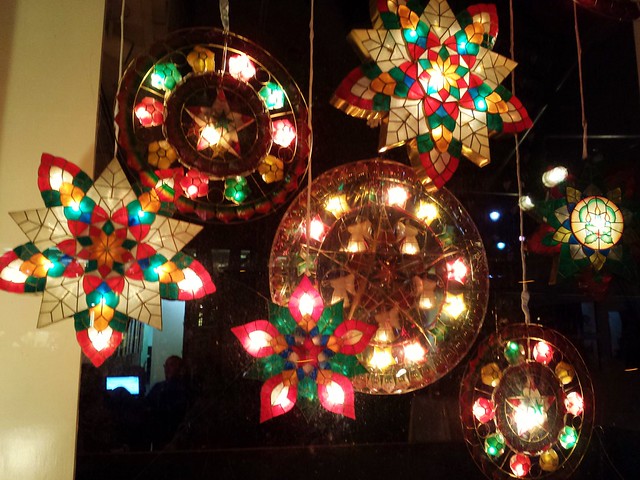
They also have their own Christmas traditions such as the 'parol' which is a bamboo pole or frame with a lit star-shaped lantern on it. It's traditionally made from bamboo strips and colored Japanese paper or cellophane and represents the star that guided the Wise Men. It is the most popular Christmas decoration in the Philippines.
Christmas Eve is very important in the Philippines. Many people stay awake all night into Christmas Day! During the evening of Christmas Eve, Christians go to church to hear the last 'simbang gabi' or the Christmas Eve Mass. This is followed by a midnight feast, called Noche Buena.
The Noche Buena is a big, open-house celebration with family, friends and neighbors dropping in to wish everyone a Merry Christmas! Most households have several dishes laid out, usually including lechon (roasted pig), ham, fruit salad, rice cakes (bibingka and puto bumbong are traditional Christmas foods) and other sweets, steamed rice, and many different types of drinks.
One very special person who helps people in the Philippines celebrate Christmas is Santa R-Kayma Klaws. He is a Filipino citizen, in his 70s and is of Irish descent. He has been spreading Christmas cheer among children from poor communities by dressing up as Santa Claus during charity missions and corporate events in poor areas of the Philippines for more than 50 years. He has a 'giant motor sleigh' (an air-conditioned bus!) that is used in many missions all over the Philippines. Santa R-Kayma Klaws owns the Philippines' only reindeer farm at Mount Isarog in Barangay Sta. Cruz, Ocampo, Camarines Sur. The farm is open to the public for free. You can find out more about him and his work on his website: http://pacificsantas.com (goes to another site).
The Philippines has eight major languages, here is how to say Merry Christmas in some of them! In Tagalog, Happy/Merry Christmas is 'Maligayang Pasko'; in Ilocano, it's 'Naragsak nga Paskua'; in Ilonggo, it's 'Malipayon nga Pascua'; in Sugbuhanon or Cebuano, it's 'Maayong Pasko'; in Bicolano it's 'Maugmang Pasko' in Pangalatok or Pangasinense, it's 'Maabig ya pasko' or 'Magayagan inkianac'; and in Waray it's 'Maupay Nga Pasko'. Happy/Merry Christmas in lots more languages.
Last Updated: | Sources Information | Written by: James Cooper